
EDDM vs Targeted Mailing Lists: Which Direct Mail Strategy Makes Sense for Your Campaign?

Direct mail can do something digital messages often struggle to achieve: it places your brand directly into someone’s hands. But a successful campaign depends on far more than an attractive postcard or a well-written letter. A single missed detail in your data file, paper choice, addressing format, or postal prep can create delays, waste, and inconsistent results.
That is why a clear direct mail printing checklist matters. Whether you are sending fundraising appeals, promotional postcards, newsletters, catalogs, or recurring customer communications, a structured approach helps you move from concept to delivery with fewer surprises.
This guide walks through the essential stages of direct mail production, from audience planning and variable data printing to proofing, finishing, and bulk mailing preparation. If you manage complex print campaigns or need dependable direct mail printing services, these steps will help you ask better questions, avoid common production issues, and create a smoother path from file submission to the mailbox.
Why a checklist matters in direct mail printing
Direct mail projects involve multiple moving parts that must work together:
- Mailing lists and segmentation
- Personalized content
- Page size and format
- Paper and envelope selection
- Digital or offset production planning
- Addressing and barcode requirements
- Sorting and postal documentation
- Delivery timing and fulfillment coordination
When any one of these details is overlooked, the entire campaign can be affected. An offer may arrive late. A donor name may merge incorrectly. A self-mailer may fail to meet mailing standards. A printed piece may look excellent but prove inefficient to sort or mail.
A checklist keeps your team aligned across creative, production, purchasing, and distribution. It also helps you work more effectively with a commercial printing partner that can guide technical decisions before they become expensive problems.
Step 1: Define the campaign objective before production begins
Before choosing paper, format, or mail class, get clear on what the piece is meant to accomplish. The objective influences nearly every printing and mailing decision that follows.
For example, your direct mail objective might be to:
- Promote a limited-time offer
- Drive traffic to a store, landing page, or event
- Generate donations for a nonprofit campaign
- Deliver recurring account, membership, or program updates
- Support a sales team with targeted outreach
- Distribute catalogs or product announcements
Once the goal is clear, define the audience, timing, quantity, and response path. A fundraising appeal may require a personalized letter package with a reply envelope. A retail promotion may call for a postcard with variable offers by segment. A recurring newsletter may need efficient print and mailing workflows for repeated production.
The stronger your strategy at the start, the easier it becomes to choose the right format, data structure, and production method.
Step 2: Review your mailing list carefully
Your mailing list is one of the most important assets in any direct mail campaign. Even the best design cannot overcome poor data quality.
Before printing begins, review your list for:
- Duplicate records
- Outdated addresses
- Missing fields
- Formatting inconsistencies
- Segmentation errors
- Suppression needs, such as do-not-mail names
List processing helps clean and standardize the data so that names, addresses, and variable fields are consistent and usable for production. This step is especially important when records come from multiple sources, such as CRM exports, event registrations, donor databases, ecommerce systems, or branch office spreadsheets.
If your campaign relies on personalization, accuracy becomes even more important. A clean file supports smoother data merges and helps reduce returned mail, wasted print pieces, and awkward personalization mistakes.
Key list questions to answer
- Who should receive this mailing?
- Are there audience segments that need different messages or offers?
- Which fields will be used for personalization?
- Have you removed duplicate or ineligible records?
- Is the list formatted to match your printer’s data requirements?
Step 3: Plan personalization with variable data printing
Variable data printing allows each mail piece to change based on the recipient’s information. That might include a person’s name, company, location, donation history, membership status, product interest, or custom offer.
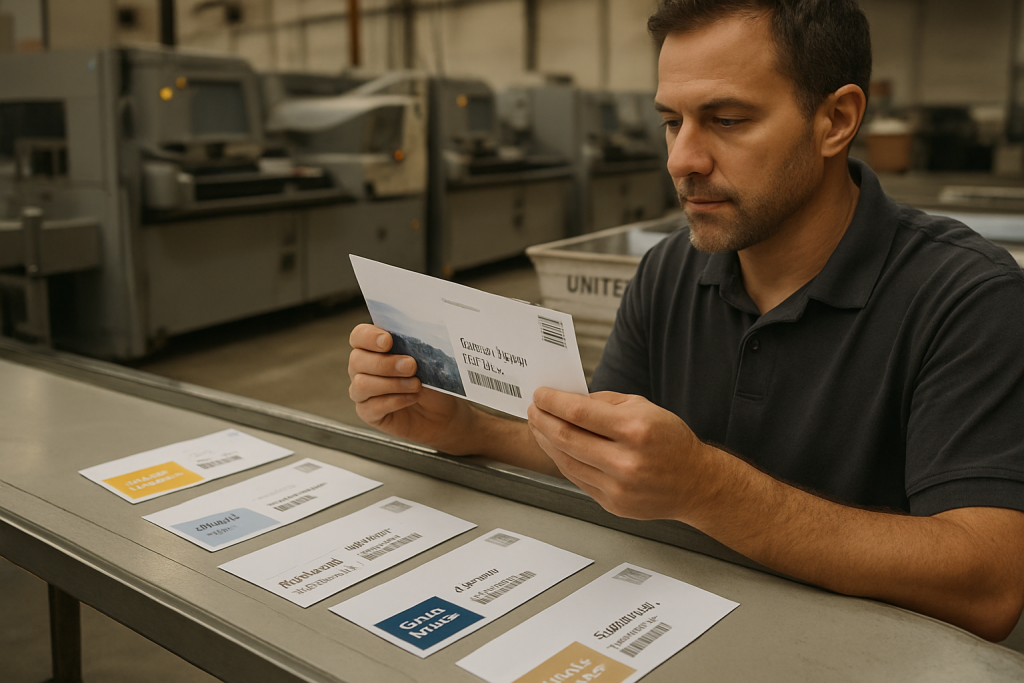
Used well, variable printing can make direct mail feel more relevant and more useful. Instead of one generic message for everyone, you can tailor content to specific audience groups or individual records.
Common variable data elements include:
- Name and salutation
- Address block
- Unique offer codes
- Personalized images
- Segment-specific headlines
- Location-specific information
- Donation asks or membership renewal amounts
- Personalized URLs or QR codes
For example, a nonprofit may send one appeal package but vary the ask amount based on prior giving history. A company may mail different product imagery to customers based on purchase behavior. A multi-location organization may use one master design while changing branch contact details by region.
The main point is this: personalization needs planning. If your design depends on variable fields, the layout must be built to accommodate content changes cleanly. Long names, empty fields, and differing copy lengths should all be accounted for in advance.
Variable data checklist
- Confirm which fields will change from piece to piece
- Check that field names in the data file match the design setup
- Identify fallback content for missing data
- Test long names, unusual characters, and formatting edge cases
- Review sample proofs from multiple segments before full production
Step 4: Choose the right mail format
The format of your mail piece affects cost, message length, response path, and production complexity. Choosing the right one depends on your campaign objective and audience.
Common direct mail formats include:
- Postcards: Great for concise offers, event promotions, reminders, and announcements
- Self-mailers: Useful when you need more space than a postcard without using an envelope
- Letter packages: Ideal for fundraising, formal communications, and more detailed messages
- Brochures or inserts: Helpful when presenting multiple services, locations, or product categories
- Catalogs: Effective for product-driven campaigns and recurring merchandise mailings
- Newsletters: Suitable for ongoing communication with members, donors, or customers
Think about what the recipient needs to understand in just a few seconds. A postcard can work well when the offer is simple and visual. A letter package may be stronger when trust, explanation, or emotional appeal matters more.
| Format | Best Use | Advantages | Considerations |
|---|---|---|---|
| Postcard | Promotions, reminders, announcements | Quick to read, visually direct, no envelope needed | Limited space for detailed messaging |
| Self-mailer | Service highlights, menus, event details | More room than a postcard, efficient format | Must be designed to meet mailing specs |
| Letter package | Fundraising, formal outreach, renewals | More personal, supports longer messages and inserts | More components to print, assemble, and mail |
| Catalog or booklet | Product showcases, recurring campaigns | Strong for multi-item presentations and browsing | Higher production and mailing complexity |
Step 5: Select paper, print method, and finishing
Print production choices affect appearance, durability, readability, and mailing efficiency. They also shape how recipients perceive your brand.
When planning direct mail printing, consider:
Paper stock
A heavier coated stock may be appropriate for a premium postcard, while an uncoated sheet may suit a reply device or letter package better. The paper should support both the message and the mailing requirements.
Digital versus offset printing
Digital printing is often a strong choice for personalized campaigns, shorter runs, and fast versioning. Offset printing may make sense for larger quantities or jobs requiring tight color consistency across long runs. An experienced commercial printing team can help evaluate the best fit based on quantity, personalization needs, schedule, and format.
Finishing options
Finishing may include folding, trimming, tabbing, inserting, sealing, or bundling. These details matter in direct mail because they influence not only presentation but also postal compatibility.
A beautifully designed piece still has to survive production, transport, and delivery. The practical details count.
Step 6: Build the artwork for mailability as well as design impact
Designing for direct mail is different from designing a digital ad or brochure that will never enter a postal stream. Your artwork must leave room for addressing, indicia, barcodes, folds, and clear zones while still looking polished.
As you prepare the layout, make sure to account for:
- Trim size and bleed
- Safe margins for text and logos
- Address block placement
- Space for postal indicia or permit information
- Barcode clear areas
- Folds, tabs, and panel orientation for self-mailers
- Envelope window placement when applicable
This is where many avoidable errors happen. A strong creative concept can run into trouble if the addressing area overlaps key design elements or if fold panels are arranged incorrectly for mailing.
For recurring campaigns, it is worth creating standardized templates that already account for postal and production requirements. That can improve consistency and reduce revisions over time.
Step 7: Proof everything, especially personalized fields
Proofing should never be treated as a final formality. It is one of the most important safeguards in the entire process.
Review both the static design and the variable elements carefully. Check spelling, phone numbers, URLs, offer dates, reply instructions, and legal or compliance copy. Then review the personalization logic itself.
Important proofing steps include:
- Approve a final layout proof
- Review data mapping for variable fields
- Check sample records from different audience segments
- Inspect addressing format and placement
- Verify envelope and insert coordination if using a package
- Confirm that QR codes, coupon codes, and personalized URLs function correctly
If the project includes multiple components, such as a letter, reply form, outer envelope, and inserts, proof them together as a full package. A direct mail campaign should be reviewed as a recipient experiences it, not only as separate files.
Step 8: Confirm quantities, versions, and production logic
Complex campaigns often include more than one version. You may have audience segments, branch-specific versions, donor levels, language variations, or different offer codes. Before printing begins, confirm how many versions exist and how each one connects to the data.
Questions to answer before approval:
- How many total pieces will print?
- How many versions or segments are included?
- Which records map to each version?
- Are there control samples or internal approval copies needed?
- Do all inserts and envelopes align with the correct records?
These details are especially important in high-volume campaigns, recurring membership notices, nonprofit printing projects, and corporate printing programs with multiple departments or locations.
Step 9: Prepare for bulk mailing preparation
Bulk mailing preparation involves much more than bundling pieces and handing them off for delivery. Mail needs to be organized, addressed, sorted, and documented according to applicable postal requirements and campaign specifications.
Depending on the project, mailing prep may include:
- Addressing
- Inkjetting or labeling
- Barcode application
- Presorting
- Traying or sacking
- Postal paperwork
- Drop planning or entry coordination
- EDDM setup when appropriate
Good mailing prep helps reduce delays and keeps the campaign moving efficiently. It also supports better consistency when organizations run repeat mailings on a monthly, quarterly, seasonal, or annual basis.
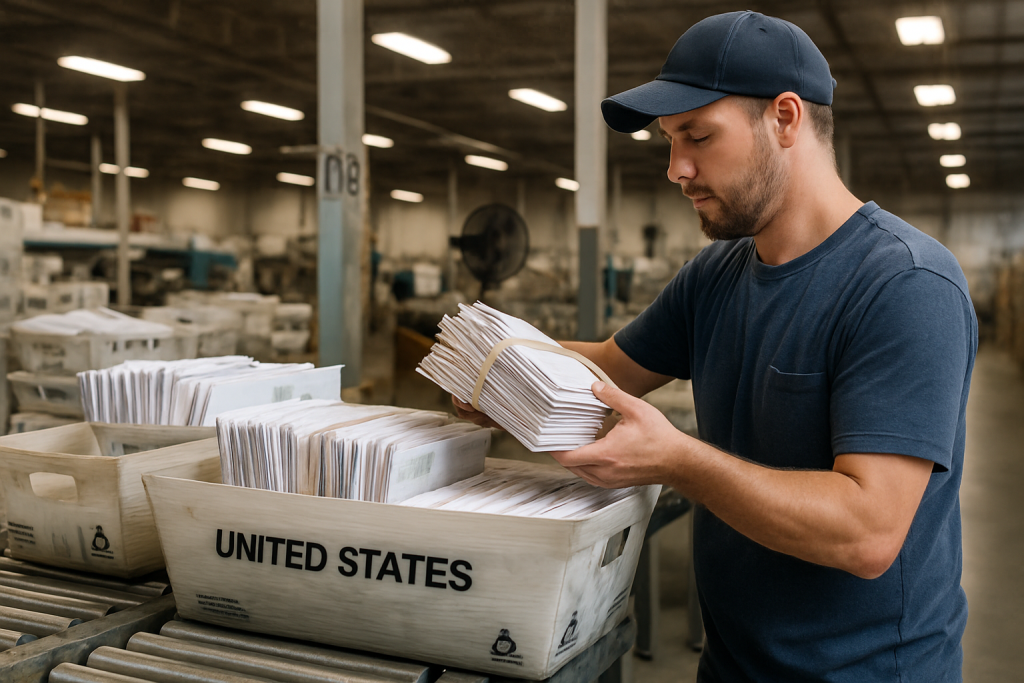
If you are comparing direct mail printing services, ask whether list processing, addressing, sorting, and postal preparation are handled in-house or coordinated through outside vendors. A streamlined workflow can simplify communication and reduce handoff issues.
Step 10: Understand EDDM, bulk mail, and targeted list mailings
Not every direct mail campaign uses the same mailing approach. The right option depends on your audience and message.
Every Door Direct Mail
EDDM is useful when you want broad neighborhood coverage without using a named mailing list. It can work well for local service promotions, openings, awareness campaigns, and area saturation efforts where household-level targeting is sufficient.
Targeted list mailings
If your campaign depends on personalization, donor history, account information, or customer segmentation, a named list is the better route. This is where variable data printing becomes especially valuable.
Bulk mail
Bulk mail programs can support more cost-efficient distribution for qualifying campaign volumes, but the pieces must meet specific preparation and mailing requirements. Planning early helps avoid redesigns or production adjustments later.
Choosing the right approach is not just a postal decision. It affects creative strategy, data needs, print specifications, and fulfillment planning.
Step 11: Coordinate fulfillment, warehousing, and distribution needs
Some direct mail campaigns are one-time drops. Others are part of a larger print distribution system. If your organization manages inventory, kitted materials, or multi-location deployment, direct mail may need to connect with broader fulfillment operations.
For example, you may need to:
- Store printed materials for future use
- Kit mail pieces with additional collateral
- Ship campaign materials to branches or field teams
- Manage staggered release dates
- Coordinate direct mail with signage, brochures, or sales materials
This is especially relevant for organizations running recurring print campaigns, franchise or multi-site programs, nonprofit appeals, and corporate communications. Looking at the full distribution picture can save time and reduce duplication across vendors and departments.
Step 12: Plan timing backward from the in-home date
One of the most common campaign mistakes is focusing only on the print date instead of the desired delivery window. Direct mail should be scheduled backward from when you want recipients to receive it.
Build in time for:
- Creative development
- Internal approvals
- Data cleanup
- Variable setup
- Proofing and revisions
- Printing and finishing
- Mail sorting and postal entry
This is especially important for time-sensitive campaigns like fundraising drives, seasonal promotions, event invitations, enrollment periods, and product launches. If timing matters, involve your print partner early rather than after creative is already locked.
Common direct mail printing mistakes to avoid
Even experienced teams can run into preventable issues. Watch for these common problems:
- Submitting incomplete or inconsistent data files
- Leaving no room for address blocks or barcodes
- Failing to test variable data logic
- Choosing paper or folds without considering mailability
- Approving pieces without reviewing live samples from multiple segments
- Underestimating the time needed for postal prep
- Treating print, mailing, and fulfillment as separate decisions instead of one workflow
The more complex the campaign, the more valuable it is to work with a team that can manage production details in a coordinated way.
How to use this checklist when selecting direct mail printing services
If you are evaluating vendors, this checklist can also help you choose the right partner. Ask practical questions about how the provider handles file review, personalization, postal prep, and ongoing campaign support.
Look for a printing partner that can help with:
- Data-driven personalization
- Digital and offset production planning
- Addressing and sorting
- EDDM and bulk mailing preparation
- Kitting, warehousing, and fulfillment
- Quality control across recurring campaigns
For substantial or repeat projects, a full-service commercial printer can often provide better continuity than splitting design, printing, mailing, and distribution among several disconnected vendors. Clear coordination helps protect brand consistency and makes complicated projects easier to manage.
Conclusion
A strong direct mail campaign is built long before the piece enters the mail stream. Clean data, thoughtful personalization, practical format choices, accurate proofs, and careful postal prep all contribute to a smoother process and a more professional result.
Use this direct mail printing checklist as a working tool, not just a planning document. It can help your team catch problems early, improve internal coordination, and make better use of variable data printing, bulk mailing preparation, and full-scale direct mail printing services. When the details are handled well, direct mail becomes more than a printed piece. It becomes a reliable part of how your organization communicates, promotes, fundraises, and builds trust through print.
[don_ai_article_cta]
Related posts


