
EDDM vs Targeted Mailing Lists: Which Direct Mail Strategy Makes Sense for Your Campaign?

When printed materials are used across multiple offices, branches, retail sites, campuses, or fundraising teams, inventory can become surprisingly difficult to control. One location runs out of brochures before an event. Another has boxes of outdated flyers taking up storage space. A third places a rush order for business cards because no one realized stock was low. The result is familiar: wasted money, inconsistent branding, shipping headaches, and unnecessary stress.
Strong print inventory management solves these problems by bringing visibility, planning, and structure to how printed materials are produced, stored, distributed, and replenished. For organizations that rely on recurring print campaigns, sales collateral, direct mail pieces, event materials, or branded stationery, a better system can reduce waste while making sure every location has what it needs.
This is especially important for organizations managing multiple stakeholders. Marketing teams want consistency. Operations teams want efficiency. Purchasing departments want cost control. Local teams want fast access to materials without waiting for last-minute approvals. The challenge is building a process that supports all of those goals at once.
Here is how to manage print inventory across multiple locations without constantly running out, overordering, or losing control of your brand assets.
Why Multi-Location Print Inventory Gets Complicated Fast
Print inventory looks simple on the surface. You design a piece, print a quantity, and send it where it needs to go. But once materials are shared across multiple locations, complexity rises quickly.
Common issues include:
- Different locations use materials at different speeds
- Staff reorder based on guesswork instead of actual usage
- Older versions stay in circulation after a redesign or policy change
- Bulk orders save on unit cost but create storage and obsolescence risk
- Materials are spread across closets, offices, and local storerooms with no centralized tracking
- Emergency reprints cost more and disrupt timelines
- Shipping from one site to another adds confusion and delays
In many organizations, no single person has a complete picture of what is on hand, what is being used, and what should be reordered. That is where multi-location print management becomes essential. Instead of treating each order as a one-time purchase, it treats print as an ongoing operational asset that needs planning, oversight, and coordinated distribution.
Start With a Complete Inventory Audit
Before improving your system, you need a clear baseline. An inventory audit helps you understand what materials exist, where they are stored, how fast they are used, and which items may be overstocked or at risk of running out.
Begin by listing every printed item your organization uses regularly, such as:
- Brochures and flyers
- Sales sheets and product inserts
- Catalogs and booklets
- Business cards and stationery
- Direct mail components
- Fundraising materials
- Posters, banners, and event signage
- Forms, envelopes, and internal documents
- Kits assembled for branches, field teams, or events
For each item, document:
- Current quantity on hand
- Storage location or locations
- Monthly or quarterly usage
- Who uses it
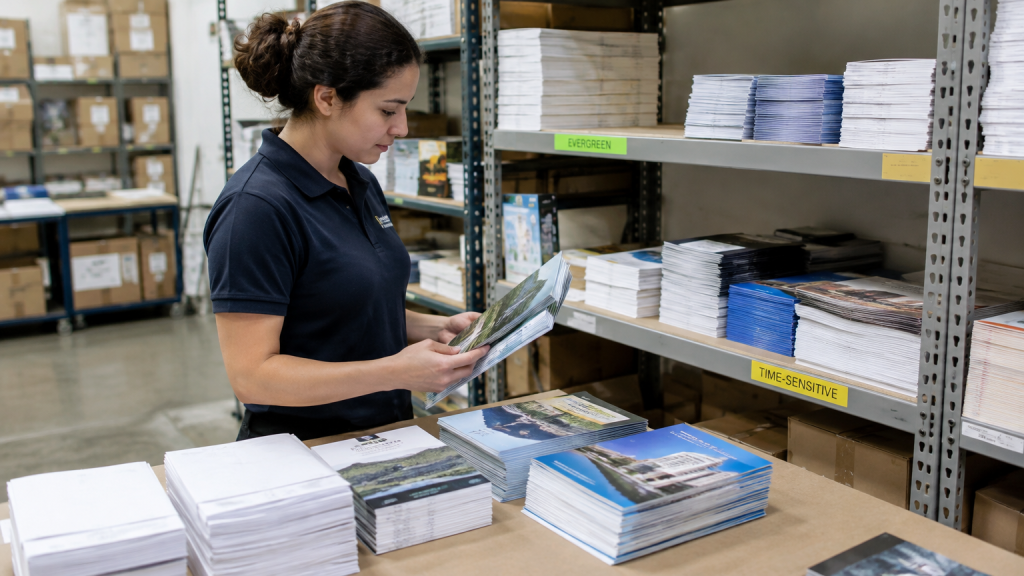
- Whether the piece is evergreen or time-sensitive
- Reorder lead time
- Version or revision date
This process often reveals hidden problems. You may find that several locations are storing the same item in excess, while another location is repeatedly placing rush orders. You may also find pieces that should be retired but are still being distributed because old boxes were never removed from storage.
Separate Evergreen Materials From Time-Sensitive Pieces
Not all print should be managed the same way. One of the biggest causes of overordering is treating every item as if it has the same shelf life.
Evergreen materials can often be printed in larger quantities and stocked for ongoing use. These might include general brand brochures, return envelopes, standard business stationery, or nonseasonal inserts. Time-sensitive pieces, on the other hand, carry more risk. These include event programs, dated promotional flyers, campaign-specific fundraising materials, product sheets with changing specs, or literature tied to a short-term offer.
Separating materials into these categories helps you decide what should be warehoused and what should be printed in smaller, more controlled runs.
| Type of Material | Best Inventory Approach | Primary Risk |
|---|---|---|
| Evergreen brochures and stationery | Print in larger quantities and store for scheduled replenishment | Brand updates or gradual overstock |
| Campaign-specific direct mail pieces | Print closer to use date with tighter quantity controls | Leftover obsolete stock |
| Event materials and signage | Order by confirmed attendance or location need | Waste after event ends |
| Business cards with employee details | Use smaller batches or on-demand ordering | Changes in staff or titles |
| Catalogs and publications | Forecast carefully and combine print runs with staged distribution | Storage burden and version changes |
This distinction is central to effective printing fulfillment and inventory planning. When you match print quantities to the useful life of each item, you reduce both shortages and waste.
Forecast Demand by Location, Not Just Company-Wide
One of the most common inventory mistakes is ordering based on total annual usage without understanding how that usage is distributed. A company may know it uses 50,000 brochures a year, but that number alone does not tell you how much each branch, sales territory, or program team needs at any given time.
Accurate forecasting should account for:
- Location size
- Foot traffic or customer volume
- Seasonal demand
- Upcoming campaigns or events
- Sales team activity
- Fundraising cycles
- Regional program differences
- Growth or staffing changes
For example, one office may use presentation folders steadily throughout the year, while another only needs them during trade show season. A nonprofit chapter may need donation reply devices heavily during year-end campaigns, while another location relies more on event programs and sponsor materials.
Forecasting by location helps you avoid a common problem: one site consumes inventory faster than expected while another quietly holds months of surplus. Better allocation improves availability without necessarily increasing the total quantity ordered.
Set Minimum and Reorder Points for Key Items
Once usage patterns are clear, define inventory thresholds for your most important pieces. A minimum level is the amount that should always be on hand before replenishment is triggered. A reorder point accounts for both usage and lead time, helping you place orders before stockouts occur.
This is particularly important for materials that directly support revenue, outreach, or daily operations, such as:
- Sales collateral used by field teams
- Fundraising reply materials
- Corporate stationery and envelopes
- Location-specific promotional handouts
- Frequently distributed direct mail inserts
Without reorder points, teams often rely on visual checks or memory. That works until a busy week, staffing change, or event surge causes supplies to disappear faster than expected. Defined thresholds create a more disciplined system and reduce rush ordering.
Centralize Ordering and Version Control
Across multiple locations, inventory problems are often really version-control problems. Different teams may download old files, reorder from outdated PDFs, or submit custom requests that drift away from approved branding.
A centralized ordering process reduces those risks. Instead of having each location manage print independently, maintain a controlled library of approved materials, current artwork, standardized specifications, and fulfillment instructions.
Centralization helps with:
- Brand consistency across all locations
- Preventing outdated pieces from being reordered
- Simplifying approvals
- Tracking usage by item and by location
- Reducing duplicate or unnecessary orders
- Coordinating changes when messaging or visual identity is updated
This does not mean local teams lose flexibility. It means they draw from a managed system rather than starting from scratch. In practice, that can be the difference between a branch receiving a polished, current brochure and one using a version that no longer reflects the organization accurately.
Use Warehousing and Distribution to Avoid Clutter and Delays
Many organizations try to save money by shipping large quantities of print directly to every location at once. Sometimes that works. But often it creates crowded back rooms, poor tracking, and unnecessary waste when materials become outdated before they are used.
That is where warehousing and distribution becomes valuable. Instead of sending every piece everywhere immediately, you can print efficiently in larger runs, store inventory centrally, and release smaller quantities to each location as needed.
This model offers several advantages:
- Less on-site storage burden for local teams
- Better visibility into total inventory levels
- Controlled release of current materials
- Reduced risk of local overstock
- Easier support for new locations or temporary campaigns
- More predictable shipping and fulfillment workflows
For organizations with recurring print needs, central storage paired with scheduled distribution can be much more efficient than a patchwork of one-off deliveries. It also supports better quality control, since materials remain in a managed system until needed.
Match Print Runs to Fulfillment Strategy
The right print quantity is not just a pricing decision. It is also a fulfillment decision. A lower unit cost on a large run may look attractive, but it is not always the best overall value if the inventory sits too long, ties up cash, or becomes obsolete.
When planning quantities, consider the full picture:
- How often locations need replenishment
- How much storage space is available
- How likely the content is to change
- Whether items can be versioned by audience or location
- How quickly a piece is consumed
- Whether kitting or staged shipping will be used
For example, a catalog may benefit from a larger print run combined with staggered distribution if the content will remain relevant throughout its intended cycle. A compliance-related insert with changing information may be better suited to shorter runs with more frequent updates. A direct mail campaign may require precise quantities tied to mailing lists and response windows rather than broad estimates.
Effective printing fulfillment aligns production volume with how materials actually move through your organization.
Create Standard Kits for Recurring Needs
If multiple locations regularly need the same mix of printed materials, consider building standard kits. A kit might include brochures, forms, reply envelopes, signage, handouts, and other components packaged together for a branch opening, recruiting event, donor campaign, trade show, or sales launch.
Standardized kits simplify inventory management because they turn several separate items into one predictable fulfillment unit. They also reduce packing errors and save time for local teams that would otherwise need to request items individually.
Kitting is especially useful when:
- Events follow a repeatable format
- New locations need the same startup materials
- Franchise or branch teams require consistent launch packages
- Fundraising campaigns use standard combinations of printed pieces
- Sales teams need coordinated leave-behind materials
This approach makes distribution more organized and supports a more consistent brand presentation in the field.
Plan for Direct Mail and Print Inventory Together
Organizations often treat direct mail production and general print inventory as separate workflows, but they affect each other more than many teams realize. If inserts, reply envelopes, buck slips, or promotional pieces are used across multiple campaigns, they need the same level of tracking and replenishment as any other printed material.
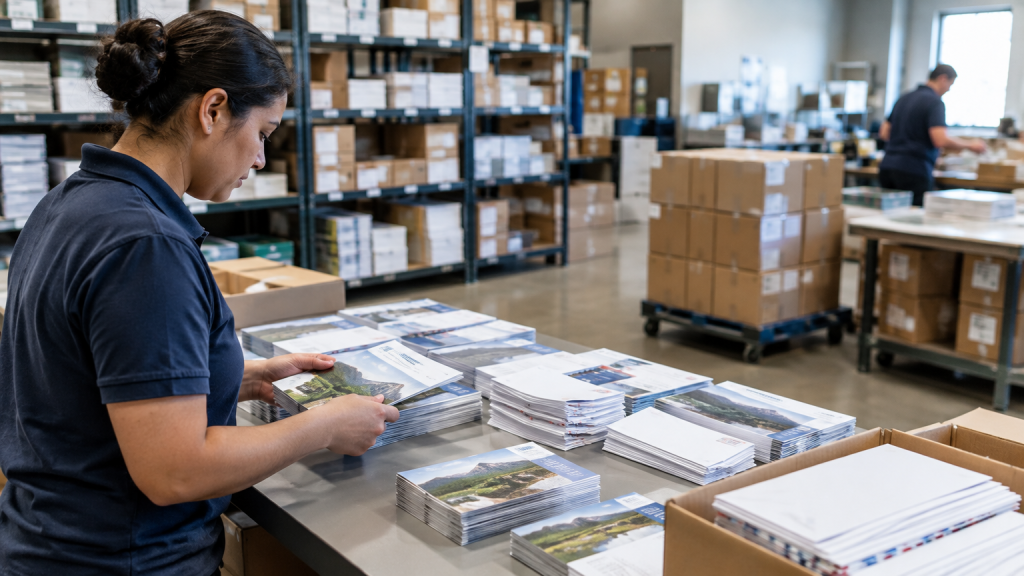
For businesses and nonprofits running recurring outreach, integrating direct mail printing with broader inventory planning can improve timing and reduce duplication. Materials can be produced with future campaigns in mind, stored appropriately, and pulled into mailing projects when needed. Variable data components, mailing lists, addressing, sorting, and preparation can then be coordinated without scrambling for missing pieces.
This is especially important when campaign windows are fixed. If one critical insert is out of stock, the whole mailing may be delayed or require a costly reprint. Inventory discipline protects campaign readiness.
Track Obsolescence Risk Before It Costs You
One of the biggest hidden expenses in print inventory management is obsolescence. Materials become unusable because branding changes, staff information changes, product details are updated, regulations shift, or a campaign simply ends. Boxes of obsolete print represent money already spent with no future return.
To reduce this risk:
- Review slow-moving items regularly
- Flag materials with expiration dates or short relevance windows
- Avoid overprinting customized pieces with details likely to change
- Use smaller runs for highly specific or seasonal materials
- Rotate stock so older versions are used first when appropriate
- Retire outdated inventory quickly to prevent accidental distribution
The goal is not to eliminate all leftover inventory. Some residual stock is unavoidable. The goal is to prevent predictable waste by recognizing which items carry the highest chance of becoming outdated.
Give Stakeholders Clear Roles
Inventory systems break down when ownership is vague. Marketing may approve artwork, purchasing may manage vendor relationships, operations may oversee distribution, and local teams may place requests. If no one is responsible for monitoring stock levels and coordinating decisions, shortages and overordering become inevitable.
A stronger process assigns clear roles for:
- Approving designs and revisions
- Forecasting usage
- Authorizing print runs
- Managing inventory records
- Requesting replenishment
- Coordinating shipping and delivery
- Retiring outdated materials
These responsibilities do not need to be complicated, but they do need to be defined. Even a simple structure can dramatically improve consistency when several departments or locations depend on the same printed assets.
Review Inventory Performance Regularly
Print inventory should not be set once and forgotten. Organizations change, campaigns evolve, locations open or close, and usage patterns shift. A quarterly or seasonal review can help you refine quantities, remove weak points, and improve future planning.
Look at questions such as:
- Which items ran out sooner than expected?
- Which pieces remained overstocked?
- Which locations consistently ordered more or less than forecasted?
- Did any materials become obsolete before being used?
- Were rush reprints needed?
- Did shipping patterns suggest a better distribution model?
These reviews turn inventory management into a continuous improvement process rather than a recurring emergency.
Why the Right Print Partner Matters
Managing inventory across multiple locations is easier when your printer is more than a vendor that simply produces a job and ships it out. Complex organizations often need support that connects production, storage, version control, fulfillment, and distribution.
A print partner with in-house capabilities and experience in commercial printing services can help organizations think through practical questions such as:
- Which materials should be printed offset versus digitally?
- What quantities make sense based on usage and change frequency?
- Which pieces should be warehoused for staged release?
- How should kits be assembled for recurring campaigns?
- What is the best way to coordinate print with mailing and shipping workflows?
That kind of support is valuable for corporate printing programs, nonprofit printing and fundraising printing efforts, catalog printing, large-format printing for events, and any recurring initiative that depends on the right materials reaching the right place at the right time.
Conclusion
Managing print across multiple locations does not have to mean constant shortages, cluttered storage rooms, and expensive last-minute orders. With better print inventory management, organizations can forecast more accurately, standardize ordering, protect brand consistency, and distribute materials where they are needed without tying up unnecessary budget in overstock.
The most effective systems combine practical forecasting, disciplined reorder points, centralized version control, and thoughtful warehousing and distribution. When those pieces work together, multi-location print management becomes far more predictable and efficient. Instead of reacting to inventory problems after they happen, your team can stay ahead of demand and keep printed materials moving smoothly through every location you support.
For organizations with recurring campaigns, multiple branches, or complex distribution needs, improving your fulfillment process is not just about storage. It is about making sure your printed materials continue to support sales, outreach, fundraising, and brand presentation without interruption.
[don_ai_article_cta]
Related posts


